Awareness Days, Awareness Months… and Awareness Fatigue?
By: Kathryn Jellings, 3SC Director, 3SC
7th September 2026
For those of us working in neuroinclusion, diversity, equity and inclusion, it can feel like the busiest time of the year.
ADHD Awareness Month, Dyspraxia Awareness Week, Dyslexia Awareness Week, Developmental Language Disorder (DLD), Awareness Day and OCD Awareness Week.
The calendar quickly fills with webinars, awareness campaigns, internal communications, guest speakers and social media posts. Every worthy cause seems to be competing for attention.
And it inevitably raises a question:
“Do we still need awareness days and awareness months, or have they become tokenistic?”
It’s a debate that is becoming increasingly common. Some organisations and institutions have consciously moved away from dedicated awareness campaigns in favour of embedding inclusion throughout the year.
My son’s school is one example. Rather than focusing specifically on Black History Month, they have made a deliberate effort to ensure Black voices, experiences and contributions are woven throughout the curriculum all year round. The reasoning is simple: if representation matters, why limit it to a single month?
It is a compelling argument, and one that we should perhaps be asking of neurodiversity too.
Should we need ADHD Awareness Month to start conversations about neurodivergence? Should organisations really be waiting for Dyslexia Awareness Week before thinking about accessibility? If inclusion is genuinely embedded, shouldn’t it happen every day of the year?
In an ideal world, yes. But the reality is more complicated.
The problem with stopping at awareness
The strongest criticism of awareness campaigns is not that they exist, but that they often become the goal.
- An organisation runs a webinar.
- A few statistics are shared.
- Employees attend a lunchtime session.
- A colourful social media graphic is posted.
- Then everyone moves on until next year and nothing changes.
When awareness exists without action, it can quickly become performative. Employees notice when organisations celebrate neurodiversity while maintaining recruitment processes that unintentionally exclude neurodivergent candidates. Staff recognise when awareness campaigns are not followed by meaningful support, adjustments or changes to working practices.
Inclusion cannot be achieved through communication campaigns alone.
And yet, dismissing awareness entirely may be equally problematic.
Awareness is still an important first step
At 3SC, we often talk about neuroinclusion as a journey rather than a destination.
Our Neuroinclusive Workplace Maturity Model reflects this progression. Organisations typically move through several stages:
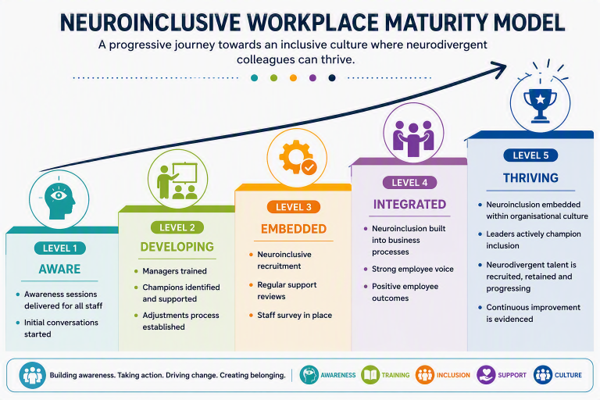
The important point is that awareness sits at the very beginning of the model.
You cannot effectively train managers before awareness exists. You cannot build inclusive recruitment processes if leaders do not understand why they are needed.
You cannot create a thriving neuroinclusive culture without first starting conversations.
Awareness may not be sufficient, but it is often necessary.
Perhaps we’re not there yet?
The aspiration should absolutely be to normalise conversations about neurodiversity so that they happen throughout the year. We should be aiming for a world where neuroinclusive leadership, accessible processes and inclusive workplace design are simply “how things are done”.
Many organisations are still at the awareness stage. Some are beginning to develop their approaches. Fewer have successfully embedded neuroinclusion into recruitment, management practices, wellbeing strategies and organisational culture.
Even fewer are truly thriving.
Until more organisations reach those later stages of maturity, awareness initiatives continue to have a role to play.
Perhaps instead of asking whether awareness months should still exist, we should ask:
“What happens next?”
If awareness leads to better manager training, more effective adjustments, inclusive recruitment processes and stronger leadership behaviours, then it has served a valuable purpose.
If it remains a standalone event with no lasting impact, then the criticism of tokenism is justified.
So, should we keep marking these days?
My answer is yes, but with a challenge.
Let’s stop judging awareness campaigns by attendance figures, hashtags or the number of awareness days in the organisational calendar.
Instead, let’s judge them by whether they help organisations move from being merely aware to becoming truly thriving.
The long-term goal should be a world where neurodiversity is embedded naturally into leadership, culture, education and organisational practice every day of the year.
But if we’re honest, most organisations are not there yet.
Until they are, awareness days and awareness months still have an important place.
The key is recognising that they are not the destination.
They are simply the first step on the journey.